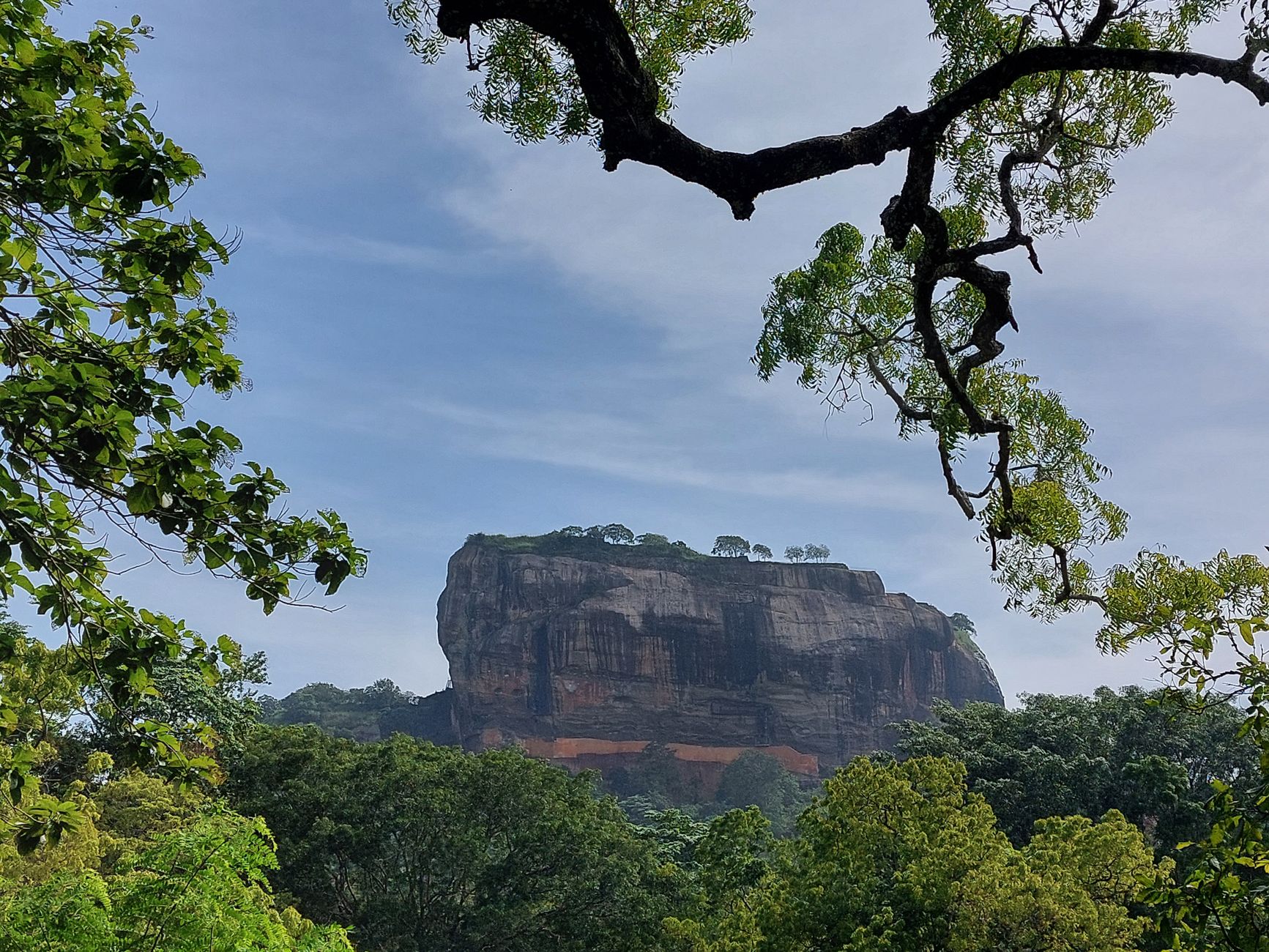
Sigiriya is a physically demanding fortress climb with extraordinary panoramic payoff. Dambulla is a cave temple complex requiring minimal effort but delivering serious historical depth. Most visitors to the Cultural Triangle should do both in a single day — but if you must pick one, here's how to decide. The two sites sit just 18 km apart, and a combined day trip is entirely realistic.
What exactly are you looking at with each site?
Sigiriya is a 5th-century rock fortress rising 200 metres from the surrounding jungle. King Kashyapa built a palace on its summit around 477 AD, and the climb takes you past world-famous frescoes painted into a sheer rock face, a mirrored wall with ancient graffiti, and the famous lion paw gateway before you reach the summit ruins. The views over the surrounding plains and jungle canopy are genuinely stunning — on a clear morning, the horizon stretches 80 km in every direction.
Dambulla Cave Temple is a UNESCO-listed complex of five caves cut into a granite outcrop, containing 153 Buddha statues and paintings covering 2,100 square metres of ceiling and wall — the largest area of cave paintings in Sri Lanka. The caves date from the 1st century BC, making Dambulla considerably older than Sigiriya. The climb to reach them is a moderate 10-15 minutes on a paved path; the reward is inside the caves themselves rather than at a summit.
Related: Galle vs Mirissa: Which Suits Your Trip?
Related: Ella vs Haputale: Which Suits Your Trip?
How do the two climbs actually compare?
This is where the sites diverge most sharply.
Sigiriya involves roughly 1,200 steps spread over about 1.2 km of ascent. Some sections use steep metal staircases bolted onto the rock face. There are exposed sections with sheer drops on one side. For most adults with average fitness, expect 45-75 minutes up and 30-45 minutes down. The final spiral staircase to the summit is narrow and can create a bottleneck if it's busy. People with vertigo, mobility limitations, or young children who need carrying should think carefully — this is a genuine physical undertaking, not a stroll.
Dambulla is a different category entirely. The path from the car park to the cave entrance is steep but short — around 150 metres of elevation gain over 15-20 minutes. Almost anyone can manage it, including older travellers and older children. The experience inside the caves is largely flat walking on smooth surfaces.
If physical effort is a constraint for anyone in your group, Dambulla is the clear choice. If the group is fit and willing, Sigiriya offers something more dramatic.
Which has the better historical and cultural content?
Both are genuinely important, but they reward different types of interest.
Sigiriya's cultural highlights — the frescoes, the water gardens at the base, the mirror wall — are spread across the climb. You need to budget time at each point rather than rushing to the top. The summit itself has evocative ruins but not extensive intact structures. The frescoes, showing 21 surviving figures from what was originally a much larger gallery, are remarkable and unlike anything else in Sri Lanka.
Dambulla's cave interiors are dense with Buddhist iconography accumulated over 22 centuries. If you spend time reading what's in front of you — reclining Buddhas, standing Vishnu figures, intricate painted ceilings — you can easily fill two hours inside the caves. The historical layering here is extraordinary: you're looking at additions and restorations spanning from 1st century BC through to the 18th century.
For religious and art history interest: Dambulla edges ahead. For sheer spectacle and physical adventure: Sigiriya wins clearly.
What's the practical case for doing both in one day?
The 18 km between sites makes a combined day entirely logical. Most travellers base themselves in or near Sigiriya or Dambulla town and hire a tuk-tuk or car for the day.
The sensible order is Sigiriya first, Dambulla second. Start Sigiriya at opening time (7:00 AM) to beat the heat and the midday crowds. By late morning you'll be done, and Dambulla — being less physically taxing — handles the warmer afternoon well. The caves also stay relatively cool inside regardless of external temperature.
Entrance fees for both sites are set in USD for foreign visitors, with a significant difference between the two — Sigiriya's fee is notably higher and reflects its premium status as one of Sri Lanka's most visited landmarks. Check current rates with your accommodation or at the Cultural Triangle ticket offices, as fees are revised periodically.
Sigiriya vs Dambulla: a direct comparison
| Factor | Sigiriya | Dambulla | |---|---|---|| | Physical demand | High (1,200+ steps, exposed sections) | Low-moderate (15-20 min climb) | | Time needed on site | 3-4 hours | 1.5-2.5 hours | | Best for | Active travellers, panoramic views | All fitness levels, religious art | | Age of site | 5th century AD | 1st century BC | | Crowds | Very high at midday | Moderate | | Entrance fee | Higher | Lower | | Vertigo risk | Yes, real consideration | Minimal |
Which should you prioritise if you genuinely only have time for one?
Choose Sigiriya if: you're fit and able, you want the most visually dramatic single experience in Sri Lanka, and you're comfortable with heights.
Choose Dambulla if: anyone in your group has mobility limitations, you're travelling with young children, you have a stronger interest in Buddhist art and history over physical adventure, or budget is a significant consideration.
But honestly — the 18 km gap and the complementary nature of the two experiences make skipping either one a decision you'll likely regret. From Kandy, both sites are around 2.5-3 hours by road and are commonly combined with a broader Cultural Triangle circuit. If you're planning your Central Province loop, the best time to visit Sigiriya is the dry season between January and April, when morning visibility from the summit is at its clearest.
FAQ
Can children do the Sigiriya climb? Children who are confident walkers and comfortable with heights can manage it — many do. However, the narrow staircases and exposed drops make it unsuitable for children who need to be carried, and parental judgement on vertigo sensitivity matters here. Dambulla is more reliably manageable for families with young children.
Is Sigiriya worth the entrance fee compared to Dambulla? Sigiriya's fee is significantly higher, which catches some travellers off guard. Most people who complete the climb consider it worthwhile given the scale and uniqueness of the site. If budget is tight, Dambulla offers exceptional value and comparable UNESCO-level significance for considerably less.
What time do both sites open? Sigiriya opens at 7:00 AM and closes at 5:30 PM. Dambulla Cave Temple opens at 7:00 AM and closes at 7:00 PM. Arriving at Sigiriya right at opening is strongly recommended — the heat and crowds both increase substantially by mid-morning.
Do I need a guide at either site? Neither site requires a guide, but both benefit from one. Sigiriya's water gardens and frescoes have significant context that's easy to miss without explanation. Dambulla's 153 statues and painted scenes are considerably more meaningful if you can identify what you're looking at. Licensed guides are available at the entrance to both sites.